Thursday, April 8, 2021

Reading Charts and Graphs Quiz at Quia.com

 Click the link below to practice answering questions about charts and graphs!

LINK: READING CHARTS AND GRAPHS QUIZ


Below are some pictures of sample questions from the quiz (clicking on these pictures will do nothing--click the link above to take the quiz):


Sunday, March 21, 2021

Irregular Verbs Grouped by Pattern

Recently I posted a link to a list of the 50 most common irregular verbs in the English language. Here is another list of the 50 irregular verbs used most often (I didn't bother to check whether the same 50 verbs were on both lists--maybe one of you will compare the lists and let me know!). It only lists the first two parts (base form and simple past form) of the 50 verbs, but it is in alphabetical order, and practice exercises follow the list:

LINK: Top 50 Irregular Verbs and Practice Exercises

Some people find it helpful to learn the principal parts of irregular verbs by the patterns they follow rather than by learning a list of the most common. The same website (www.englishhints.com) also has a page that groups irregular verbs by the patterns they follow. Best of all, it has advice on ways to study these lists, depending on whether you learn best by seeing, hearing, or moving (writing).

My Suggestion: Click on the link below to go to the 12 lists. Read the sections on How to Study Irregular Verbs and Using the Lists. Then make your own copies of the lists. If you like to have something handy to study when you're riding the bus, waiting for class to start, or taking a break, copy the lists onto 12 or more note cards that you can easily carry in a pocket, wallet, or purse. You can buy lined or unlined cards in various sizes, or you can make your own. Try some of the suggested ways of studying the principal parts such as writing them 10 times, or having someone quiz you, or reciting them over and over.

 LINK: 12 Lists to Help You Learn Common Irregular Verbs

Ways to Learn the Principal Parts of Irregular Verbs

Here is the Oxford Advanced Learner Dictionary definition for "principal parts": the forms of a verb from which all the other forms can be made. In English these are the infinitive (for example swim), the past tense (swam) and the past participle (swum). We also call the infinitive form (to swim) the base form of the verb.

What is the best way to learn the principal parts of irregular verbs? Some people like to study with lists on paper. Others like to make flashcards or have a friend quiz them. One of the best ways to learn the parts of irregular verbs is to write sentences using them. For example:

Manuel woke up and got out of bed. He put on clothes, went to the grocery store, and bought some milk. The milk cost $3.29. He brought the carton of milk home, put it in the refrigerator, and wrote down how much money he spent at the store. He sat at his desk and taught himself some new English vocabulary words. Later he took the milk out of the refrigerator, poured some on his cereal, and ate it for breakfast. He also drank coffee with a little milk in it. Then he put his dirty dishes in the sink, left the house, and drove to work. He got gasoline on the way to work and kept track of how much he spent in a little notebook he always left in the car.

All of the verbs in the above paragraph are simple past tense. They are all irregular verbs except for one. The one regular verb is the only verb NOT written in darker italic letters. Can you find the only verb in the paragraph that forms the past tense in the regular way (by adding -ed or -d to the base form)? Here is a hint: Pablo opened up really enormous doors.

Another way to learn the principal parts of irregular verbs is to play the Listen and Repeat videos at manythings.org. Listen to and repeat the three parts of each verb.

My suggestion: Click on one of the first two links to practice principal parts with Listen and Repeat videos. Click on the third link to take four quizzes (in the blue box area)--fill in the blank with the simple past form of the irregular verb shown at right.

LINK: Listen and Repeat Irregular Verbs 

LINK: Fill in the blank with the simple past of these irregular verbs

New Study Stack Flashcards--Irregular Verb Practice

Test your knowledge of the simple past form of 50 irregular verbs:

LINK: Past Form of 50 Irregular Verbs

Wednesday, March 3, 2021

Participial Adjectives--Video

This video explains the difference between participial adjectives ending in -ed and those ending in -ing:


Participial Adjectives--Bored or Boring?

There's a difference between participial adjectives that end in -ed and those that end in -ing, as these cartoons show:


Thursday, December 17, 2020

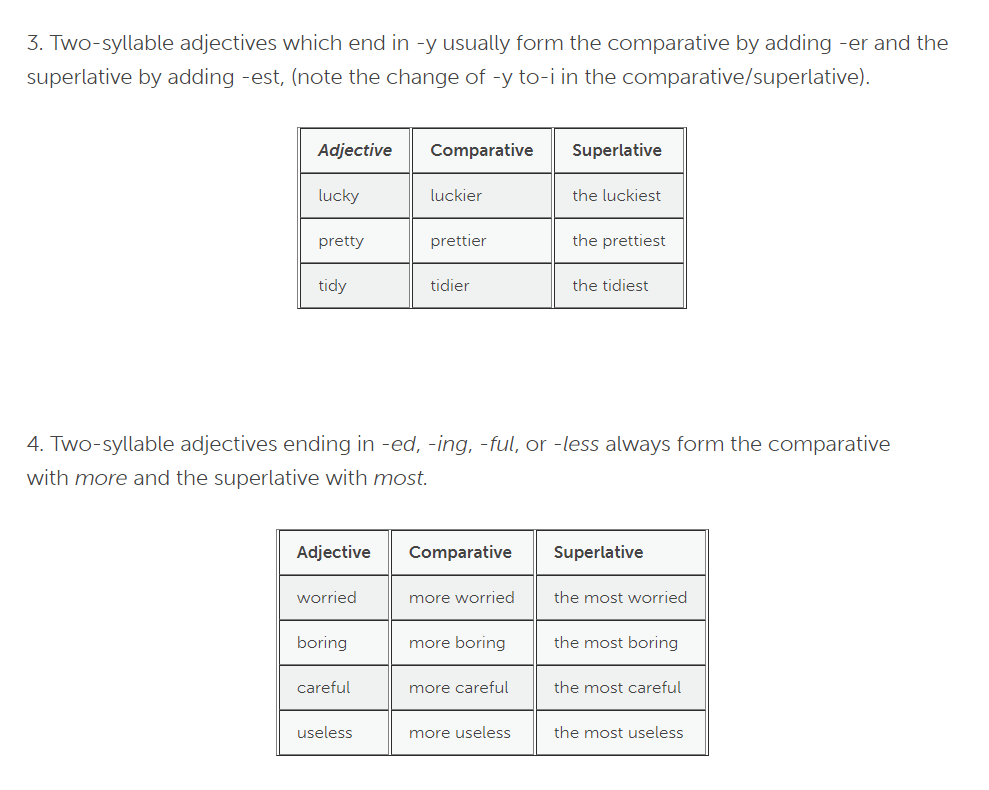
Rules for Comparative and Superlative adjectives

When do you simply and the -er (comparative) or -est (superlative) ending to the adjective, and when do you have to use more or most instead? 

Here are some charts from onestopenglish.com that show some of the basic rules (I have not provided a link to the site itself because you have to register before you can view material on this website:


Wednesday, December 9, 2020

Quizzes on Comparative and Superlative Adjectives

Click the first link below to take a quiz on comparative adjectives. The second link will take you to a similar quiz on the superlative form of adjectives.

For each quiz, you will see an empty box with a sentence underneath. Choose the adjective from the box at the right of the page and put it in the proper form (comparative for the first quiz and superlative for the second) to complete the sentence.


LINK: Comparative adjectives quiz


LINK: Superlative adjectives quiz


Sunday, November 29, 2020

REALLY NICE Explanation of Possessive Adjectives & Pronouns, Chart Showing the Different Kinds of Pronouns

Oh, I like this post at myenglishpages.com!

  • There is a lesson that explains the difference between possessive adjectives and possessive pronouns.
  • There are links to lessons on the different types of pronouns (subject, object, possessive, reflexive).
  • There's a lovely chart that lists these different types of pronouns for 1st, 2nd, and 3rd person, singular and plural.
  • There are links to quizzes and related topics.
  • There's a link to a silly poem that uses possessive adjectives. You can click on the link and read the poem, but BEWARE! If you then click on the link to the YouTube video, you'll be watching big purple Barney the Dinosaur and his friends sing the song. Some of us watched plenty of Barney on tv when our children were little--no more, please!

Notice that I practiced using "There is," "There are," and the contraction "There's" in the above list. But I did not use "There're" as a contraction for "There are," because that contraction does not exist in English--BEWARE!


My suggestion: Read the lesson on possessive adjectives  and review the pronoun charts by clicking the first link below. 

LINK: Lesson on Possessive Adjectives

Then try this quiz on possessive adjectives and check your answers:

LINK: Grammar Exercises--Possessive Adjectives

To review possessive pronouns, click this link:


Then try the exercises at this link:

Possessive Adjectives and Possessive Pronouns--Listening Lab

To follow up on yesterday's class, practice recognizing possessive pronouns or adjectives in speech! The website www.learnamericanenglishonline.com has a Listening Lab section. You can read and listen to (at the same time) sentences that show how to use many elements of grammar: verb tenses, various kinds of pronouns, comparative adjectives and adverbs, prepositions, modal verbs, negative verbs, passive voice, etc.

Clicking on an exercise brings up a page on which you will see a rectangular box with a picture of Teacher Paul. Click the arrow beside Teacher Paul's picture to hear him read the sentences that are printed below the box, filling in the answer blanks as he reads. Further down the page you can look at the answers he used for the blanks. Below the answers there is a link that you can click on for further help understanding the topic.

My suggestion: Click on the link below and then choose an exercise to listen to (the possessive adjectives listening exercise is #3, and the possessive pronoun exercise is #9).

LINK: Listening Lab Exercises

Friday, November 20, 2020

Summary and Quiz on Subject and Object Pronouns

Click on the link below to see a summary of the difference between subject and object pronouns. Then test your ability to use them correctly by taking the quiz that follows the explanation.

LINK: Subject and Object Pronouns at efl.net


Wednesday, November 18, 2020

Practice Map-Reading Skills While Relaxing!

Do maps on the TABE reading tests scare you? Maybe you haven't spent a lot of time looking at different kinds of maps or studying how to interpret them. However, here is a fun and relaxing way to get used to working with maps and answering questions about what they show.
 

My suggestion: Do you like to color? Some adults get out colored pencils and color their own pictures while their children play with crayons and coloring books. It's very relaxing, and your kids may even want to join you. If you click on the link below, you will see many images that can help you practice reading and understanding maps, keys (legends), and distance scales. Click on a few map pictures and study them, or print them out, get some colored pencils, and try doing the activities and answering the questions. I have lots of colored pencils in my classroom in you want to try it!

LINK: Click on this link to print a map activity sheet or view it online

Below are some examples of map learning activities you will see when you click on the link above:

Monday, October 19, 2020

Reading Skills Practice: Strategies for Better Reading

Reading tests have a time limit. They try to find out whether you read English well enough to quickly understand the meaning, of what you read. We call this skill reading comprehension (comprehension means understanding). To read well, you have to improve your vocabulary, but you also have to work on other reading skills: inferring, predicting, and identifying the main idea.

If you read well enough to understand what the author intends, you should be able to draw conclusions about what you are reading, or to predict what will probably happen next. Sometimes we call this skill "reading between the lines," or inference. To infer means to use what the author directly says to conclude or predict something that he author doesn't actually state.

My suggestion: Click on the link below to practice inferring, predicting, and identifying the main idea.

LINK: Strategies for Better Reading: Understanding, Predicting, Inferring 

Here is a sample question from this activity:


Making Inferences

Making inferences is an important reading skill. An inference is a guess you make based on what is stated and on logic. An inference isn't something that is stated directly in what you read. You have to make a logical guess or conclusion that isn't stated based on information that is stated in what you read. Here's an example from the quiz below:

     Don't sneeze when someone is cutting your hair. (Why would someone give this advice?)

My suggestion: Click on the link below to take a quick quiz on making inferences based on advice given by children. You have to infer the reason for the advice.

LINK: Quiz on Making Inferences

Thursday, October 15, 2020

Another way to study grammar--Animations (cartoons)!

Here is a link to ESL Blues, a website that offers a lot of lessons and quizzes (at different levels) for people studying English:

ESL Blues

 It also teaches grammar lessons by animations. An animation is a drawing or picture that seems to move. We watch animated tv shows called cartoons. We also see animation in computer games and in videos. Turning a positive statement into a question or into a negative statement requires changing the normal English word order, adding a helping verb or negative word, and/or changing the tense of the main verb. For example: He walked yesterday. Did he walk yesterday?He did not walk yesterday. 

Animation lets you watch the words in a sentence move around as these changes occur. Seeing words float into and out of a sentence is another way to help you remember the changes that occur when we make a positive statement into a negative statement or a question.

My suggestion: Click on the "ESL Blues" link above. After the page loads, look at the Alphabetical Index on the left side. Click on Animated Grammar Tutorials and then choose some of the links to watch. Or just use the links below to watch two of these "anigrams" (the ESL Blues website's name for these animated videos):

Past Tense: Negative Forms
Past Tense: Yes/No Questions 

Friday, August 28, 2020

Reading Skill Practice: Summarizing and Finding the Main Idea

Finding the main idea in what you read takes practice. You have to learn to tell the difference between main idea statements and detail statements. You often have to recognize a summary (a brief statement of what the reading is mainly about) or a paraphrase (a statement that says the same thing, but with different words). You also have to learn to group details into categories by identifying what they have in common. Seeing what statements have in common helps you to identify the main idea of what you are reading, or to summarize it with different words..

My suggestion: Click on the link below to learn how to summarize and how to tell the difference between the main idea and the details that support the main idea.

LINK: Finding the Main Idea and Summarizing


Wednesday, May 13, 2020

Wednesday, May 13, 2020 Announcements and Assignments

Wednesday, 5/13/20

Announcements
1) Below is some information Ann O'Leary sent to the teachers, about testing and registration for fall classes. Please read it carefully:


Registration and Testing for Fall Classes
IF we can be at school
Outreach Center
301 Avenue of the Cities, East Moline, IL
309-796-8245

You must register and test to attend fall classes. We hope to be at school for registration and for classes. IF we cannot be at school, we will let you know what you can do.


  • Only 10-15 people will register at a time. We will practice social distancing when possible. Plan to wait or come back.
  • You must wear a face mask. 
  • No children under 18 allowed.


If we are full, we will ask you to wait or come back another day.
More registration dates will be added.

Registration will be at 9:00, 2:00, and 5:30. Please be on time.
July 6, 8, 13, 15
August 3, 5

If there is room in your class, you will start on Monday, August 17. If the class is full, I will call you when you can begin class.

2) Our last online class is Friday, 5/15/20. I appreciate your patience and attendance as I was learning how Zoom meetings work. I am also very happy that many of you have been practicing on Burlington English regularly. Please continue to do so this summer, for as long as you have access (you should be able to use it at least through June).

3) The answers to all class assignments through Monday, 5/11/20 (except for those on Burlington English), are now posted in the Homework Answers section.

Assignments from Wednesday, 5/13/20 (due Friday, 5/15/20)

1) Future English 3 textbook, pp. 190-192 

p. 190--Study the grammar boxes at the top of the page (on participial adjectives). Do exercises A and B

p. 191--Do exercises A and B

p. 192--Study the words for internal parts of the body in the box. If you don't know what a word means, look up the definition in your language. Do Exercise A: write the number of the body part next to the name for it in the box.

2) Future English 3 workbook, p. 112

p. 112--Do exercises A and B

You do not have to send me the above two assignments. We will go over the answers in class, then I will post the answers on this blog.

3) Burlington English Lower Intermediate Core
    
Do Lesson 5 (Health), section 6 (Grammar: Adjectives with -ed and -ing)

4) Extra (optional) work:

I have two posts on this blog which help you understand the difference between an adjective with an -ed ending and an adjective with an -ing ending. Click the links below:

LINK: Cartoon and examples of using adjectives ending in -ed and -ing

LINK: Participial adjectives--short animated video

Tuesday, May 12, 2020

Tuesday, May 12, 2020 Assignments for 5/13/20

Tuesday, 5/12/20--

I gave homework to the online class yesterday (Monday, 5/11), but forgot to post the assignments here for anyone who wasn't able to attend the online meeting. I apologize for my lateness.

Assignments (due Wednesday, May 13) *

*    Since I didn't post the following assignments until today, you don't have to send your work to me by Wednesday. We will go over the answers in class, and then I will post them on the blog.

1) Future English 3 textbook (this finishes unit 9 for us)

p. 182--Read about reported speech at the top, do Ex. B
p. 183--practice 2 at the top of the page


2) Burlington English Lower Intermediate Core

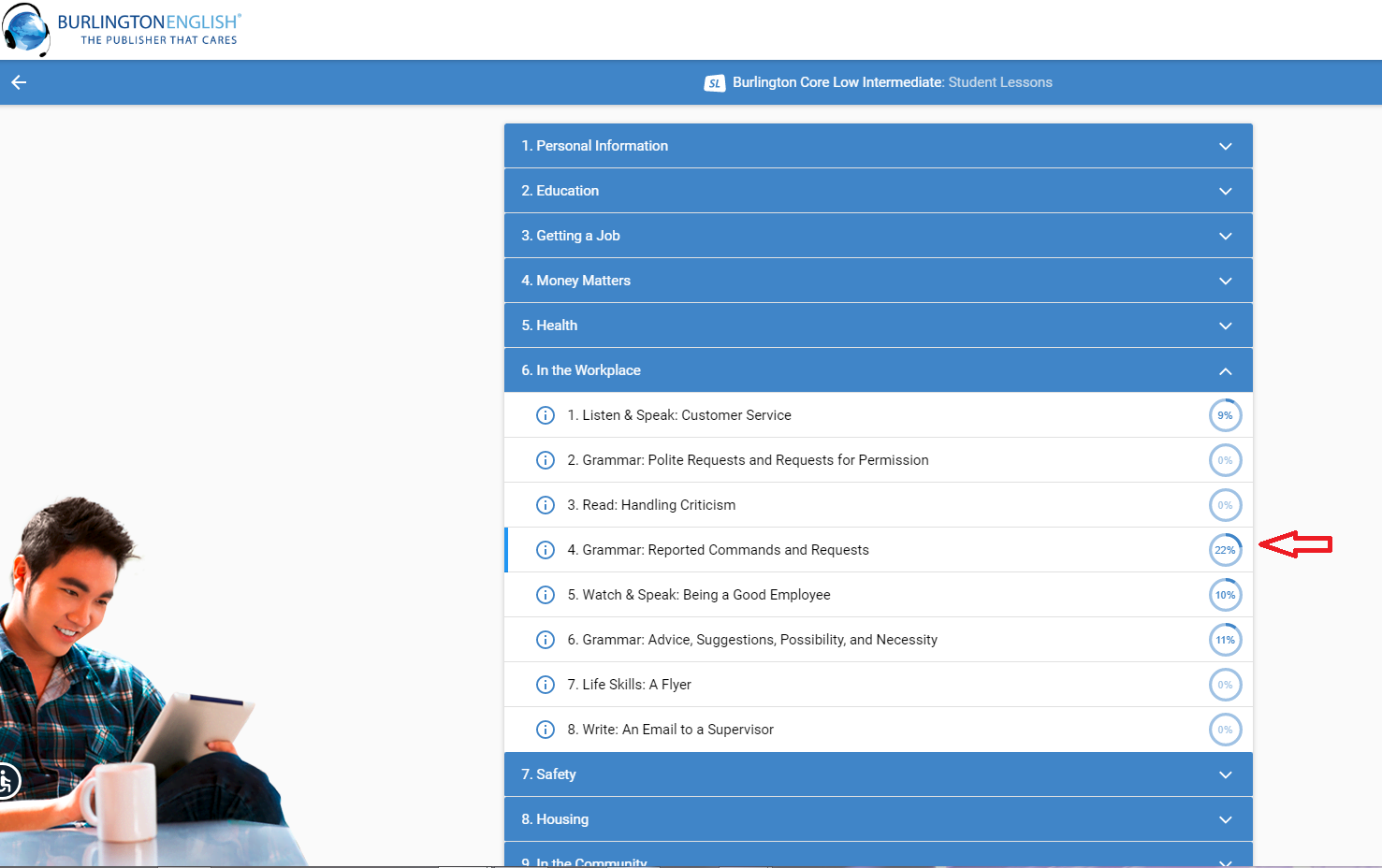
Lesson 6--In the Workplace: section 4 on reported commands and requests

Doing this section on BE will give you further practice on reported speech.


3) Future English 3 textbook--Unit 10: pp. 186-187--Vocabulary for doctor and hospital visits
  • p. 186, Ex. B
Review the vocabulary in the yellow box (places in a hospital). Look up any of these words you do not know. Then try to match the numbers of the pictures with the vocabulary.


     For example, picture #1 (with the babies) matches with maternity ward (where mothers have their babies), so put #1 in the blank in front of that term.

  • p. 187, Practice 2
On p. 187, look at the telephone numbers (these are extensions, the last part of a phone number) for the different departments in a hospital. Then do practice 2--fill in the blank with the number of the department you would call in each situation.

4) Future English 3 workbook--Unit 10: pp. 110-111
  • p. 110--Label each picture with one of the words in the box.
  • p. 111--Do exercises B, C, and D


Friday, May 8, 2020

Friday, May 8, 2020--Announcements and Assignments

Friday, 4/8/20


Announcements

1. Remember to send me your vote on whether you would like to work in unit 10 or unit 11 next week.

2. I will post the answers to Wednesday (5/3/20)'s homework this weekend, in the "Homework Answers" section of this blog.

3. Our last day of class is Friday, May 15th. Because of the virus situation, the ESL program will not have any summer school classes this summer. However, Ann O'Leary will be scheduling the usual testing/registration dates, beginning in early July (more information later). 

4. You will be able to use your Burlington English account at least through the end of June.

5. At this time, fall classes are scheduled to begin on Monday, August 17th. Of course, we do not yet know whether we will be able to meet back in our building. I will email you with more information when the college has made decisions about the fall semester.

6. I recently sent you a message by email about Teacher Linda, who is retiring after 25 years of teaching. If you were in Teacher Linda's class in the past, we would like to collect your memories or thank yous to give to her. Teacher Theresa is in charge of collecting them. Here is what the email said:


Teacher Linda is retiring after teaching ESL at Black Hawk College for 25 years!

Please help us honor Teacher Linda. How? Write 2-3 sentences about a memory. Record yourself speaking the memory or speaking a thank you. Videos should be short because many videos will be put together to make a gift for Teacher Linda.

Here are some ideas:

I’ll always remember you because_______________.
In your class, I learned ________________________.
The best thing about your class was _______________.
Thank you for ________________________________.
Send your videos to Theresa Bries at briest@bhc.edu. Put “teacher Linda” in the subject line.
Thank you so much!

Theresa


To Teacher Linda!


Assignments (due Monday, 5/11/20)

1. Future English 3 Textbook, p. 177--complete sentences in the middle of the page (#1-4)

2. Future English 3 Textbook, pp. 178-179

Read p. 178 and then do Ex. A and B
Do Ex. A on p. 179

Please send me your answers to both of the above assignments by text or email.

3. Burlington English Lower Intermediate Core
  • Do Lesson 3: "Getting a job"--section 4: "Grammar: Gerunds and Infinitives"

  • Then do all sections of Lesson 6-"In the Workplace."


NOTE: As usual, I will be able to see what you have completed in Burlington English by looking in my teacher's account progress reports.

4. Choose a book from the "Readers" section of Burlington English. Read it and write four sentences about what you read. Tell the title and author of the story, and then tell a few things you liked (or didn't like) about the book.

Here is an example (the book I'm using is not on BE):

     I read Pride and Prejudice, by Jane Austen. My favorite person in the book is Elizabeth Bennet. She is smart and funny, and she has high standards for the person she chooses to marry. Although Mr. Darcy was rich, she wouldn't marry him until he changed his proud and insulting behavior.

This was assigned earlier in the week, but you have until Monday to send me your four sentences about what you read, by text or email.